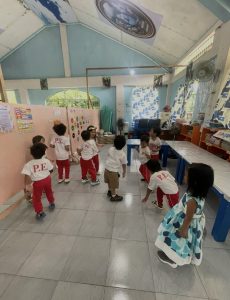

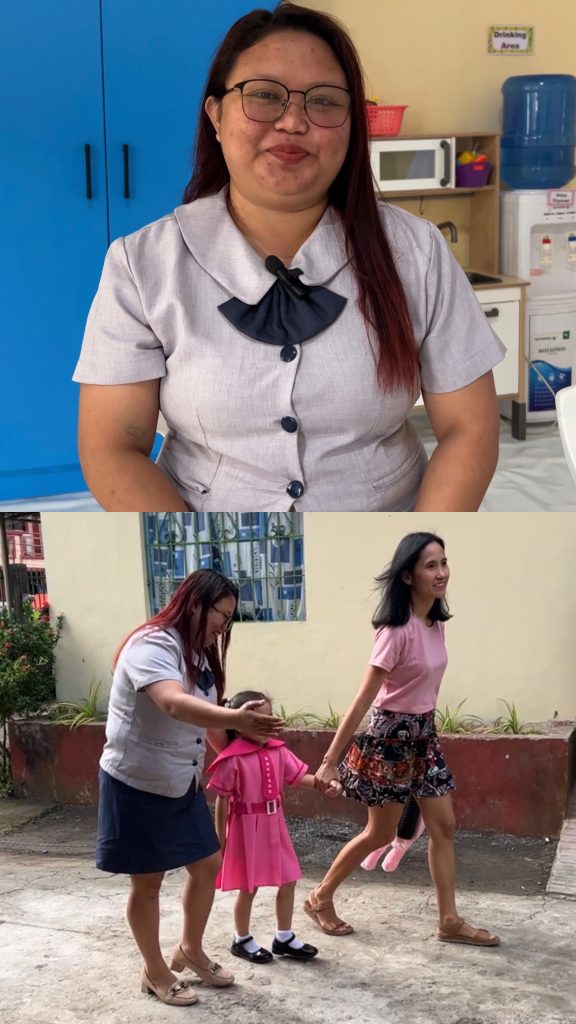
Resourcefulness has long been inherent to Filipino communities — where systems fall short, our ingenuity often steps in. In Naga City, Barangay San Felipe turns a humble chapel into a classroom, where Teacher Jessel Fausto helps shape a brighter future for her students.
The chapel-based Educare Center currently serves 12 students in the morning and eight in the afternoon. Every Monday, Teacher Jessel arranges tables, chairs, toys, and pencils to transform the chapel into a conducive learning space, and every Friday, she carefully packs everything away so the Educare Center can be used again to celebrate Sunday Mass and spread hope to the broader community.
The work is tiring, she admits, but the chance to help children learn keeps her going. “Every end po ng school year, nare-realize ko na malaki ang tulong ng Educare [Center] sa mga bata … Mga small achievement ng mga bata na alam mong naging part ka ng achievement na ‘yun,” Teacher Jessel shares.
Hundreds, even thousands of stories like Teacher Jessel’s reflect the deeper, long-standing systemic education crisis in the Philippines. Studies from the Second Congressional Commission (EDCOM 2) show that only 21 percent of Filipino children aged three to four years old are enrolled in early childhood education, and less than 50 percent of households are equipped with educational toys and books.
Most Filipino learners fail to meet learning objectives; at the end of SY 2024-2025, 48.76 percent of learners were found not to be reading at their respective grade levels. The problems compound over time: as a result of unaddressed gaps in access and support, as many as nine in every ten Filipino learners fail to read with understanding (World Bank, 2025).
Many of these mismatches in learning expectations and outcomes may be attributed to the lack of access to updated and accurate educational resources, reliable and scalable digital and physical infrastructure, few and unsupported teachers, and “mass promotion” strategies. All these, on top of scarce and unconducive educational environments, make it difficult for students to stay focused on learning.
These findings underscore the need for solutions that operate on more than goodwill. They call for expanded access to early childhood education by investing in both infrastructure and people, from converting daycares into fully equipped Child Development Centers to professionalizing and expanding the early childhood care and development (ECCD) workforce, strengthening data systems, and building families’ capacity to ensure learning continues to be nurtured at home.
Angat Buhay is rolling out a two-pronged approach to ECCD: first, by establishing safe, dignified spaces for learning, and second, by empowering the learning ecosystem — the teachers, caregivers, families, and communities who make learning possible.
Last January 23, this vision took further steps forward with the turnover of five new Educare Centers in Tabuco, San Felipe, and Pacol, made possible through the Federation of Filipino-Chinese Chambers of Commerce and Industry, Inc. and the Naga Filipino-Chinese Chamber of Commerce.
For Teacher Jessel, this news brings excitement and relief. “Na-excite po ako na magkakaroon na ng bagong center, hindi lang dahil hindi na ako mahihirapan sa dating set up kundi mas mapapaganda na ang center ng mga bata at makakatulong ito sa kanilang learning process,” she said. “Hindi lang ang mga bata ngayon ang matutulungan nito kundi ‘yung mga susunod pang bata na mag-e-enroll dito.”
The newly built centers now stand as a tangible response to a national challenge, but the chapel right across the street remains just as significant. It reminds the community that while new buildings matter, learning does not begin with concrete walls; it begins with committed and well-equipped teachers, supportive communities, and a shared belief that every child deserves a strong start. By strengthening both the physical foundations of ECCD and the ecosystem that sustains them, Angat Buhay continues to work toward a future where no child’s potential is limited by their origin or location and where even the smallest, most unassuming spaces can become places of possibility and hope.
Watch the turnover here: https://www.facebook.com/share/v/17yvvWweTG/