

“The true foundation of architecture is neither concrete nor steel. It is the people.”
For Trish Nuque, an Architecture alumna of the University of the Philippines Diliman and a graduate of Angat Buhay’s Angat Sining Arkitektura Internship Program, this isn’t just a philosophy—it is the compass of her work.
Her conviction stands in sharp contrast to the realities many Filipinos face today: corruption in infrastructure projects and the devastating toll these failures take on communities. In a field often measured by towering skylines and concrete achievements, Trish and a new generation of architects are proving that blueprints drawn with empathy may be the most radical design of all.
She first confronted this truth in her final years of study, when her batch was challenged to design projects from the ground up—identifying real problems, creating solutions, and developing proposals on their own terms. For her part, Trish designed an In-Patient Drug Rehabilitation Complex for Women in Bulakan, Bulacan, and a Wellness and Empowerment Center for Sexual and Reproductive Health and Rights in Angeles City, Pampanga.
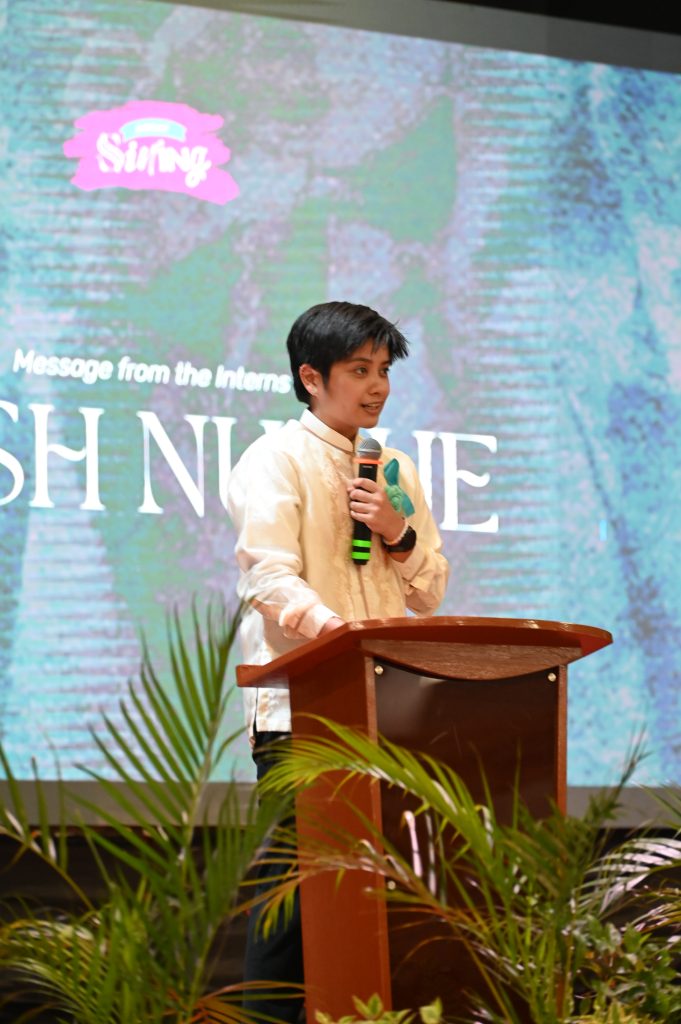
To bring these projects to life, she immersed herself in conversations with civil society leaders, healthcare workers, and registered sex workers. Their struggles and lived realities became more than data points; they became the very foundation of her design.
She carried these lessons into Angat Buhay’s Angat Sining Arkitektura Internship Program, where her belief in people-centered design was further validated. There, she saw firsthand how nation-building through architecture is possible. It was no longer just theory—it was awe-inspiring to watch professionals transform progressive design concepts into spaces that directly served communities. Even the smallest design decisions, she realized, could hold immense political and cultural weight.
As part of the program, Trish’s group also developed a capstone project entitled “Health Block by Blocks: Kalinga sa Kubo at Kalsada.” It sought to address the widespread lack of access to healthcare facilities by reimagining health infrastructure as modular, community-rooted, and accessible. Shaped by the voices of healthcare workers and ordinary Filipinos, the project was envisioned as a living module—one that could grow and transform alongside its community.
Looking ahead, Trish hopes to continue building on this foundation. “My design process will always be rooted in the needs of the community and shall be reflective of the stories of the people I encounter,” she said. With empathy as her blueprint, she is determined that her passion to serve through architecture will only deepen as she steps further into the profession.
Within Trish’s core is Angat Buhay’s belief that every structure should be designed with people at its heart. True foundations are not made of concrete alone, but of empathy, dignity, and compassion. Guided by these values, architecture becomes more than building—it becomes a way of shaping spaces that uplift the very communities they are built to serve.